
Context-Driven Hospitality: The Next Evolution


Synopsis
Rok Kokalj, Co-founder and CEO of Nevron, describes “context-driven hospitality” as the next step for an industry facing uncertainty and rising complexity. He argues that hotels should move from binary thinking to hybrid intelligence, building clear identity and purpose first so technology, especially AI agents, can support human connection and turn back-end complexity into front-end simplicity that feels seamless for guests.
Scientists, thinkers, and visionaries from all corners are saying the same thing, no matter the context they’re describing: We are living in extremely unpredictable times. The hospitality industry is probably one of the most complex industries there is, since it is braided by so many influences and factors, and is strongly dependent on all sorts of context, from geography and culture to technology to the most unpredictable one, people's moods and behaviour.
When looking into the future and trying to navigate through all the upcoming changes, unexpected turns, and countless speculations, one can easily get lost in the overwhelm. The questions, like “Where do we begin?”, “Whom do we trust?” and “Which end to hold?” reappear again and again.
My detailed observations of the world at large, the hospitality industry, and global trends keep leading me to the philosophical ground on which we might consciously build the hospitality of tomorrow. Here’s my visionary thinking on how to move with the flow, not against it.
The roots of the word hospitality
Sometimes, looking back at the basic terminology helps us anchor in the “why”, so we can find our way back to the “how”. See, where I come from, we don’t use one word for both the hospitality industry and for the phenomena or the atmosphere of hospitality. The Slovene word for the experience of hospitality is “gostoljubje,” which could be translated as “to greet your guest with an open heart.”


Hospitality is one of the last industries where human connection isn’t optional: it’s the heart of the business and the main product.
My first forward-looking thought is actually the return to the basics of human connection that we might have started to lose along the way. Hospitality is, and must remain, a human-first industry. And to bring our humanness back to the forefront again, we need to incorporate technology that handles the heavy workload so people can practice “gostoljubje”.
Embracing the complexity and non-binary thinking
Read any respectable writer, talking about anything from environmental issues to cultural dynamics or business challenges, and you’ll get to the same conclusion: to solve any of the large-scale imbalances, a new way of thinking and acting is required.
In hospitality, we can observe how people are standing on two riverbanks, which sounds like: human vs. tech; global vs. local; standardization vs. personalization; nostalgia vs. futurism; and the list goes on. Taking sides and arguing against the other opinions will push us even further down the rabbit hole. If we can incorporate non-binary thinking or start with hybrid thinking (‘and’ instead of ‘vs.’), we will see that contradictions are not problematic; they’re invitations to collaborative action.
Technology must have a seat at the table
Speaking about technology as simply a tool is an outdated perspective. Hospitality is entering an age where hybridity (human + tech) is becoming a new operating system, not merely another update. The question is whether we understand how to use technology properly (or, shall I say, collaborate with it) so it serves as a bridge between hoteliers and guests.
Technology can be our ally and is supposed to reduce friction between a guest and a host. It should create an open space for relationships between people. But what we’re seeing right now is quite the opposite of that. Today, technology is still used as the third entity in relationships, preventing people from having real contact. We need tech that keeps hospitality a people-first industry, where tech is here to enable connection, not mask it.
AI agents and the importance of context
One of the most useful tech for hospitality will be AI agents, as most of us already know. You will need to tell them stories, based on which they’ll be able to build their own characters. Bet that if you didn’t put enough thought into developing your business persona, identity, and story, your AI agent will be sort of “dry”, generic, and without many emotional intelligence factors.
AI agents are systems that perceive, decide, and act within a digital (and sometimes physical) environment. Unlike simple bots that respond to single prompts, agents can carry memory, act autonomously, collaborate with humans, adapt to situations, and learn — learn fast!
I suspect that the incorporation of AI agents will bring the most significant changes in hospitality in the next couple of years. And this technology will surely shine a light on all the contextual and branding gaps that hoteliers haven’t yet faced.
We must work on the contextuality first
Context must be one of the most underrated phenomena in business, strategy, and even in relationship dynamics. Context is literally everything. It is like glue that keeps all the pieces of the story/situation together. And the context in hospitality is still widely misunderstood.
When I speak about context, I’m also talking about identity or the personality of a hotel as a main part of your hotel. Not simply the branding, nor the décor, but the living character.
What keeps all of these aspects of the context together, what breathes life into “the bricks of your building,” are the soft themes, like: your vision, your values, what you stand for in the world, what types of experiences you want to provide for your guests, etc. Work on these, and it will be easier to “feed your AI agent” and also to stand your ground, no matter the disruption on the horizon.
Learning to translate between front-end simplicity and back-end complexity
Another hard nut to crack, and the specifics of today’s (and especially tomorrow’s) hospitality, is the widening gap between what is going on “behind the veil” and what guests see in front of them.
Hotels are wrestling with rising complexity across business models, regulations, data systems, AI tools, and more. One can easily lose one's mind trying to navigate through the labyrinths of back-end complexity. But guests simply don’t care about any of this. They want an experience that feels simple, intuitive, and comfortable.
The hardest thing is to master creating something that feels simple. It means you must tame the dragons of background complexity, so they don’t leak into front-end experience. It requires extraordinary amounts of discipline and skills to keep the logistics hidden. I think that hotels that manage to work their way through these labyrinths have a chance for a serious strategic advantage, since seamlessness is becoming a new form of luxury.
Hospitality has a larger role on the stage
I’ve put quite a bit of thought into how primary motivations for traveling have changed over the past decade or so, and how they will continue to evolve. I could say we’re experiencing radical changes in how we travel and why we do it. Travel no longer seems to be a pause or escape from life; it is life. It’s how people explore who they are becoming, how they reimagine their lives, how they create, and how they make sense of this beautifully chaotic thing called living.
I believe that hospitality is the perfect crossroads of people, cultures, ideas, and offerings, and thus it has the power to transform cultural narratives. My bold claim is that hoteliers can become facilitators of better human experiences.
Future-sight predictions
Based on my daily research, conversations with industry leaders, curiosity, and my own observations of where global patterns are heading, here are my modest predictions for the coming years:
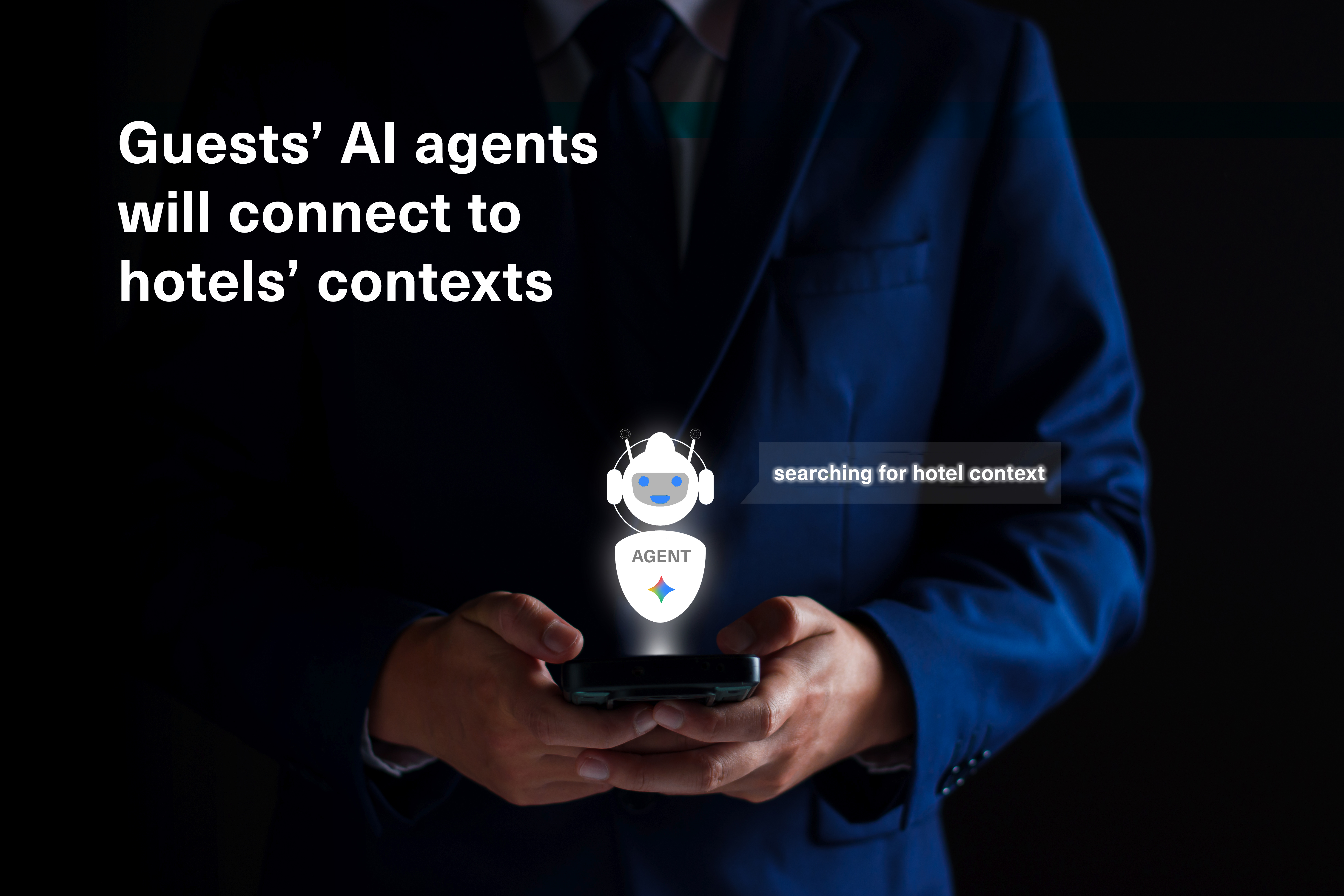
- AI agents will navigate conversations between themselves (the hotel’s agent and the guest’s agent). This means conversations will no longer be limited to humans.
- Hotels may stop copying global trends and start designing for local contextual intelligence. We strive for diversity, not sameness, and hotels have the ability to provide it.
- Simplicity will become a luxury, and friction-free journeys will define premium hospitality. We need to start treating simplicity as a gift.
- We are stepping into the era of hybrid intelligence, where, hopefully, humans and technology will collaborate and co-create.
If we learn to read context, design with intention, and collaborate with technology rather than resist it, hospitality might become exactly what people need most in uncertain times: a place where life makes sense again.