
Agentic AI: An Inflection Point for Hospitality in 2026
Synopsis
Wouter Geerts of Mews argues 2026 is when agentic AI moves from hype to quietly running hotel operations—handling routine tasks, predicting demand, and coordinating systems so staff can focus on meaningful guest interactions. The key enabler: a "semantic layer" unifying real-time data across PMS, CRS, and other hotel systems. Without it, AI can't act effectively.
Beyond the Hype: AI Moves into the Engine Room of Hotels
For years, the conversation about AI has been dominated by potential. We were asked to imagine what might be possible “one day”. Interesting, but comfortably abstract.
That is now changing. AI is no longer just black-box algorithms or only operational in demos and pilots. It’s moving into the messy, day-to-day reality of operations, quietly helping determine what work gets done, when, and by whom.
If it feels like the conversation around AI shifted overnight from hype to necessity, there’s a reason. In my recent deep dives with hoteliers, technologists, and researchers, one clear theme keeps coming back: agentic AI – the next evolutionary step beyond chatbots and rule-based automation – will start to run the core mechanics of hotels, from invisible back-office processes to those irreplaceable guest moments that define true hospitality. 2026 is the year when that shift becomes visible at scale.
The groundwork is in place; the inflection now is from potential to realization: from talking about AI, to letting it reshape how hotels actually run.
Why Hotels Are Getting Serious about AI
Traditionally, hotels have not rushed headfirst into every technology wave. In workshops and interviews, I often hear some version of the same line: We’d love to modernize, but right now we just need to get through this week.
Thin margins, complex legacy stacks, and the nonstop demands of daily operations have made it easier to delay big decisions than to rewire how hotels run.
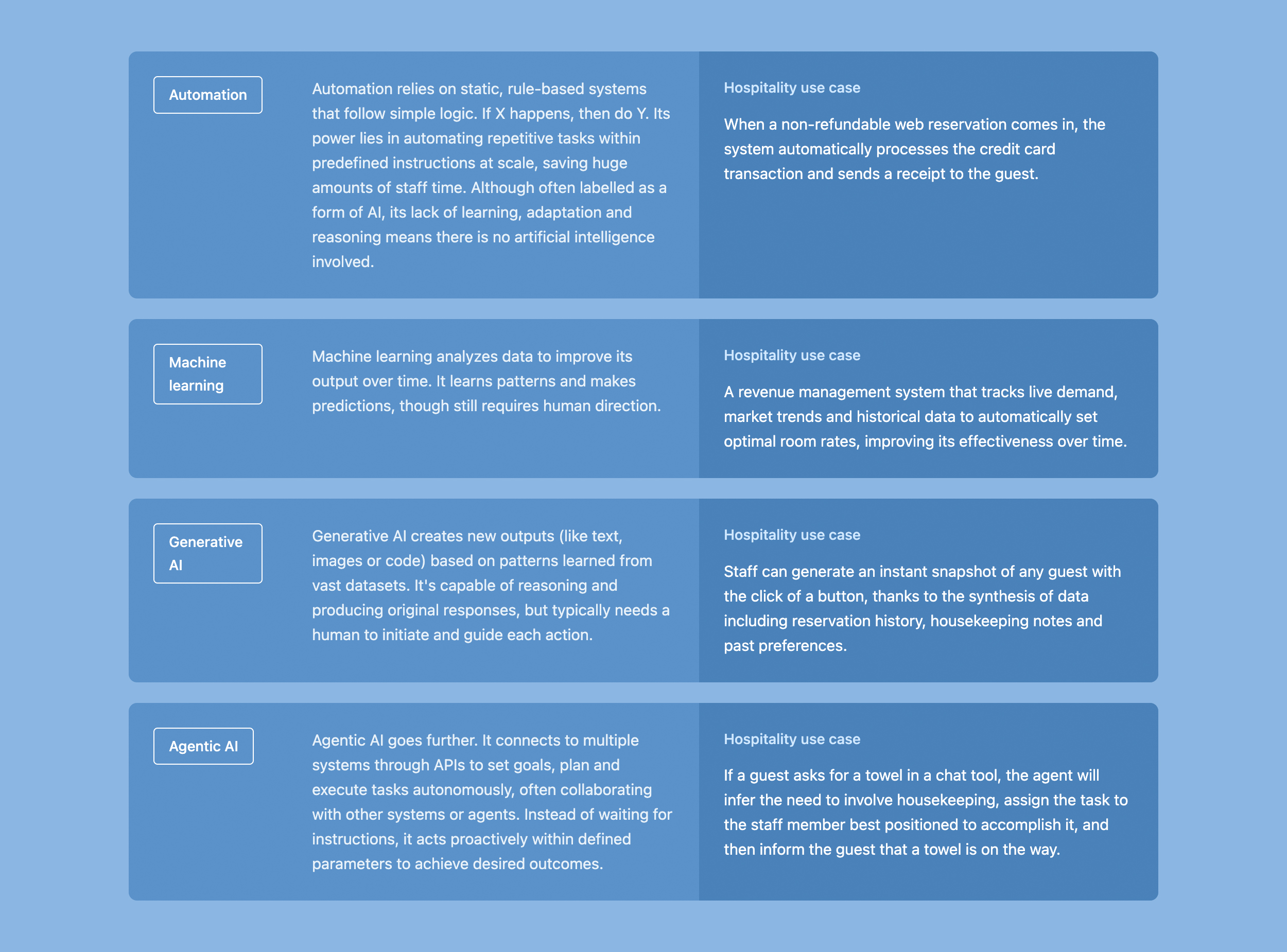
That’s changing. Powerful forces like structural labor shortages, rising costs, shifting guest expectations, and the rapid maturity of AI tooling collide with the old ways of working. Generative AI and machine learning – tools that once sounded abstract – are being embedded into core platforms. And agentic AI is knocking on the door, looking to orchestrate tasks across revenue, operations, and the guest journey in real time.
But what does this actually mean for the guest and staff? It’s not about robots at the front desk; it's about intelligent systems that quietly strip out friction so teams can spend less time firefighting routine issues, and more time on the interactions with guests that actually build loyalty and long-term value.
4 Levels of Intelligence
Impact on Operations: Less Chore, More Strategy
The promise of agentic AI for hotel operations is simple and powerful: reduce manual work, break down silos, and free staff to focus on strategic and high-touch activities. Instead of managers constantly reacting, a system predicts weekend booking surges and automatically adjusts staff schedules, or flags inventory risks before they disrupt service.
AI agents handle the repetitive, behind-the-scenes tasks – invoicing, procurement, task routing, even onboarding – and surface the decisions humans actually need to make.
That level of operational excellence has rarely been achieved consistently. Agentic AI changes that. Any property can run a tighter, more proactive operation, and hotel groups go a step further: insights and optimizations discovered at one location can be shared instantly across the portfolio, turning every property into part of a continuous learning network.
Impact on the Guest Journey: Seamless and Personalized
When I ask hoteliers what great service looks like, the answers are rarely about technology. They talk about remembering a guest’s name, fixing a problem before it turns into a complaint, or surprising someone with exactly what they need after a long journey.
Agentic AI’s role is to make more of those moments possible. It transforms the guest experience from transactional to anticipatory. Instead of aiming for “just enough” service, hotels can now deliver personalized journeys, enhanced by real-time context and historical preference. Agents help staff recognize returning guests, recall nuanced preferences (from allergies to room location and pillow type), and automate logistics – while people focus on the kind of authentic hospitality no machine can replicate.
Hoteliers should be able to decide how far to take this. Select-service hotels will lean more on visible automation and frictionless digital check-in, giving guests control and speed. Luxury properties let agentic AI work mostly in the background, quietly coordinating preferences and operations, so human staff have more time for unscripted, high-touch moments. The common thread is that every guest feels known, and every team member is empowered to focus on empathy and creativity, not admin.
The Missing Foundation: The Semantic Layer
If I had to nominate a “word of the year” for hospitality technology in 2026, it would be the semantic layer. This layer will be of growing importance for hotels. It’s not a nice-to-have; it’s the essential foundation for effective AI, particularly agentic AI, because it allows machines and humans to interact with data in a meaningful way.
For most hotels today, the tech stack is a patchwork of disconnected systems, duplicated data inputs, and brittle integrations. Agentic AI demands a reimagining of this architecture. To be effective, it must orchestrate tasks across all systems in real time – adjusting rates, managing housekeeping schedules, triggering maintenance, personalizing communications – based on a single, trusted, up-to-date view of what is happening in the hotel.
This is where the semantic layer comes in. It sits above fragmented tech stacks and translates raw, messy data from every source – PMS, CRS, RMS, guest messaging, payments – into a universal language that AI can understand and act upon. It understands your hotel and its quirks, and knows what data to pull when.
Hotels that invest in robust, connected systems are effectively laying the groundwork for this semantic layer. Put simply, a core system that cannot feed and receive clean, real-time data into a semantic layer stops being an asset and starts becoming a structural risk.
At Mews we have acquired DataChat to deepen our expertise in building this semantic layer for hotels. This will allow us to move faster into deploying operational AI agents that communicate across all hotel systems, so users can consistently deliver standout service and run leaner, more intelligent operations. Our vision is that hotels using Mews (or a similarly open, AI-ready stack) will be the most visible and competitive on tomorrow’s digital platforms, and among the most efficient in daily operations.
If you want to dive deeper into this topic, download our Agentic AI for Hotels whitepaper.
Where to Start: A Checklist for Hoteliers
Talking about implementing AI is easier than actually doing it. This is a common problem I see: hoteliers get excited when I talk about this vision, but don’t know how to actually start. Well, here you go. Use this practical, future-proof checklist as your first roadmap:
Map your data flows
List and diagram every system – PMS, booking engine, channel manager, guest communications, housekeeping, F&B, payments. Identify gaps, silos, and points of duplicated effort.
Standardize your data
Build a shared vocabulary for rates, inventory, guest attributes, and services. This not only improves your hotel’s discoverability by generative AI search tools, it also lays the groundwork for a reliable semantic layer.
Pilot targeted automations
Pick a single, high-friction task – for example dynamic staffing schedules or automated upsell campaigns – and automate it with clear oversight and KPIs. There are many tools that let you build and test agents. Start small, but start.
Train for human–AI collaboration
Bring staff into your experiments early. Show them where AI agents can take over routine work, and where human judgment is essential. Technology should enhance – not replace – the human touch.
Govern with transparency
If you want to take it further, create a small governance group to set clear policies for AI oversight, data security, and guest privacy. Decide in advance which decisions AI can suggest, which it can execute, and which always need human approval.
Review and iterate
Regularly measure outcomes – guest satisfaction, staff efficiency, revenue optimization – and refine your roadmap based on results.
Download our 2026 Hospitality Industry Outlook report for more detailed checklists, expert opinions, and case studies.
Closing: Human-First, Powered by Agentic AI
Agentic AI will not replace the essence of hospitality – it will bring it into sharper focus. The hotels that thrive in 2026 and beyond will be those that use technology to empower people, not to automate them away.
The real winners will be the ones investing in connected systems today, because only then can AI agents make a real difference. Those hotels will become the places guests want to stay – and the places staff want to work.