
The Regenerative Compass: A Moral Guide for Hospitality Leaders
Synopsis
Jonathan Normand frames regeneration as the only viable path for hospitality in a world of ecological overshoot and collapsing trust, arguing that sustainability alone is no longer enough. It introduces the 7C Leadership Compass as a practical, deeply human guide for leaders who want to align business success with the long-term wellbeing of people, places, and the planet, and positions Moral Ambition plus cross-industry coalitions as the engine of real, regenerative change.
The hospitality industry stands at a crossroads. For years, we have spoken of sustainability, implementing measurable goals and accountability frameworks that have undoubtedly moved the needle. Yet, a growing sense of "sustainability fatigue" permeates our industry, a feeling that our incremental improvements are no longer sufficient. The truth is harder to face: we are in ecological overshoot, relying on declining net energy, with planetary boundaries already breached. The extractive paradigm that has defined our civilisation is self-terminating. In this moment, sustainability will not save us. Regeneration is the only viable path.
This is not a prophecy of doom. Rather, it is a perceptual upgrade, a clear-eyed recognition that business-as-usual is incompatible with the living systems we depend upon. The question is no longer if we must transform, but how we, as leaders, authentically embed regeneration into the heart of our organisations. This transformation is particularly urgent in a world grappling with insularity, where trust is in peril and optimism for future generations has collapsed, as highlighted by the 2026 Edelman Trust Barometer [1].
From Mechanistic to Living Systems
Regeneration, at its core, is about understanding the logic of life itself, creating the conditions for ecosystems, both natural and social, to thrive. It demands a shift from a mechanistic worldview of inputs and outputs to a living systems perspective, where our businesses are seen as integral parts of a larger, interconnected whole. This is not merely an evolution of sustainability; it is a fundamental paradigm shift. And each paradigm shift involves a quiet death of the self shaped by the old worldview. It requires us to move beyond the transactional and embrace the transformational.
This shift is mirrored in the broader evolution of work itself. We are moving away from a singular focus on shareholder value toward a more holistic, stakeholder-conscious model. The new generation of talent seeks purpose-driven work, and customers are increasingly drawn to brands that align with their values. Conscious leadership is no longer a soft skill, it is a strategic imperative, especially when addressing the erosion of institutional trust and the widening mass-class divide [1].
The Answer Lies Within: Moral Ambition and the Power Paradox
The journey to regenerative leadership begins not with a checklist of external actions, but with the inner work of the leader. Modern neuroscience reveals that leadership effectiveness is deeply tied to self-awareness. As leaders gain power, their brains can actually rewire, leading to a decrease in empathy and a reduced ability to process feedback.
This "power paradox" is a significant barrier to the very qualities regenerative leadership demands: humility, empathy, and a deep sense of connection. In an era of insularity, where individuals retreat into familiar circles, leaders must actively counteract this paradox to become Lead Trust Brokers [1].
To counteract this, leaders must cultivate what I call Moral Ambition, the unwavering commitment to align personal and organisational success with the well-being of all stakeholders. This is not about moral perfection, but about conscious and continuous striving. It requires building new neural pathways, training our brains for empathy, psychological safety, and long-term thinking.
The science here is compelling. When leaders create environments of high trust, they trigger the release of oxytocin, the neurochemical of connection. Research shows that high-trust organisations report 74% less stress, 50% higher productivity, and 76% more engagement than low-trust counterparts. In hospitality, where service excellence depends on discretionary effort, this is not a soft metric, it is the foundation of competitive advantage. Oxytocin fosters collaboration and innovation precisely because it reduces fear and enables risk-taking. Regenerative leadership, then, is not merely an ethical stance; it is neurologically optimal. Furthermore, with "My Employer" now recognised as the most trusted institution (78% trust among employees), leaders have an unprecedented opportunity to bridge divides and rebuild trust [1].
The 7C Leadership Compass
To guide leaders on this journey, I have developed the 7C Leadership Compass for Moral Ambition. This is not a rigid map, but a dynamic compass that helps leaders navigate complexity with integrity and purpose. It is a spiral model of continuous growth, where each "C" builds upon the last, guiding leaders from extractive models toward a regenerative future, and offering a pathway to counter the prevailing insularity and rebuild optimism.
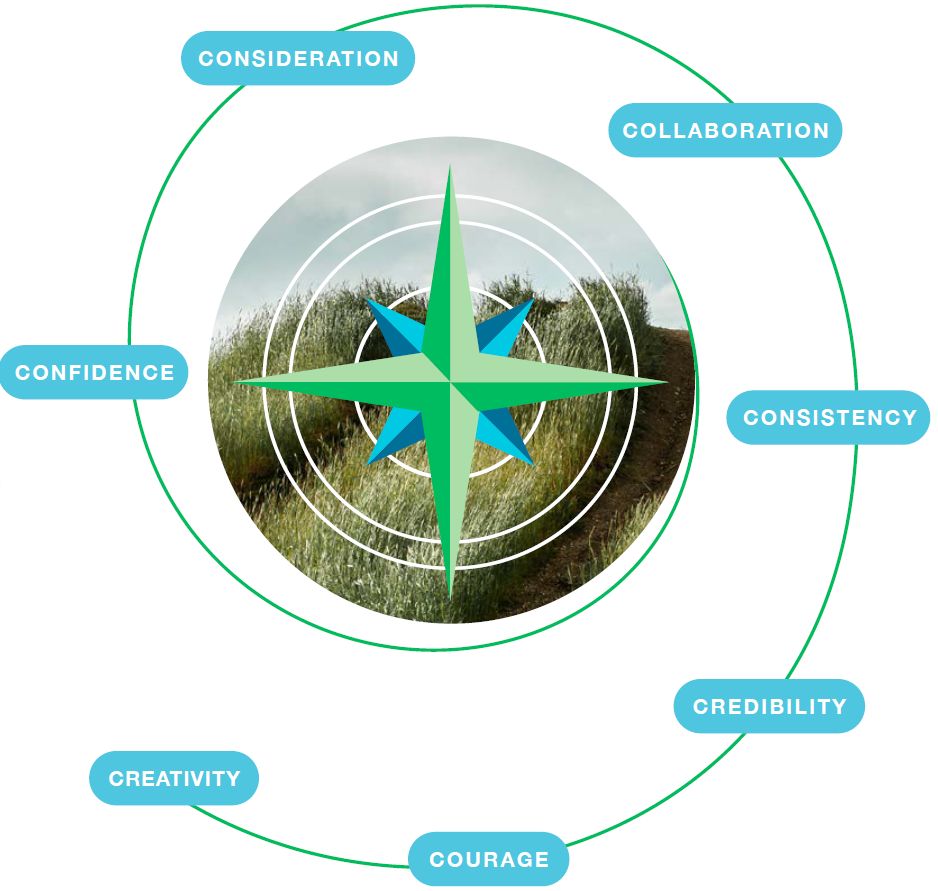
Confidence
Confidence is the foundation, inner confidence rooted in self-awareness and purpose that allows a leader to be vulnerable, to trust their team, and to create psychological safety. This is where transformation begins: the willingness to let go of the old worldview and confidently lead through periods of societal uncertainty and collapsed optimism.
Consideration
Consideration follows as the practice of deep empathy, the ability to understand and value the diverse perspectives of all stakeholders: employees, guests, local communities, and the environment. This is crucial for bridging the widening mass-class divide and fostering genuine engagement across different groups [1].
Collaboration
Collaboration is the art of mobilising collective intelligence, recognising that regenerative solutions are rarely born in silos. It is about fostering a culture where diverse voices can co-create solutions that benefit all stakeholders, directly combating the retreat into insular circles.
Consistency
Consistency is the reliable application of values, walking the talk, ensuring regenerative principles are reflected in every decision. When employees see their leaders living the values, trust deepens and commitment strengthens, reinforcing the employer's role as a trusted entity.
Credibility
From this emerges Credibility, the earned trust that underpins true influence, granting leaders the legitimacy to drive bold change. It is the natural outcome of the first four Cs, essential for leaders to be effective Lead Trust Brokers.
Courage
Courage is the willingness to challenge the status quo, to make long-term decisions that may not show immediate financial returns. This might mean investing in regenerative practices that do not show immediate financial returns, demonstrating a commitment that transcends short-term economic anxiety.
Creativity
And courage unlocks Creativity, the engine of innovation that allows leaders and their teams to imagine and build new, regenerative models of hospitality, offering fresh perspectives and solutions in a world resistant to change.
The Compass in Action
What does this compass look like in practice? Consider the hospitality and tourism coalition now forming to accelerate regenerative hospitality across the industry in 2026. Such an initiative embodies each C in action, serving as a powerful counter-narrative to insularity and a beacon of renewed optimism.
It begins with Confidence: the willingness of leading institutions to publicly stake their reputation on a paradigm that challenges business-as-usual. Consideration follows, the coalition's design process requires deep listening to diverse stakeholders: hoteliers, local communities, academics,
and ecosystem partners, actively working to bridge the mass-class divide. Collaboration is the engine: no single institution can drive systemic change; the coalition model itself is the message, fostering collective intelligence over individual silos.
Consistency will be tested as members align their internal practices with the principles they advocate. From this foundation, Credibility emerges, the earned authority to challenge an industry and act as a Lead Trust Broker. With credibility comes Courage: the willingness to set ambitious targets that may not show immediate returns, addressing economic anxieties with long-term vision. And from courage flows Creativity, the space to prototype new models, from regenerative supply chains to place-based guest experiences that give more than they take, inspiring hope and innovation.
This is not a theoretical exercise. It is regenerative leadership unfolding in real time. Imagine a hotel manager who, guided by Consideration, spends time with local farmers to co-create a truly farm-to-table experience that regenerates the local soil and economy. Picture a leadership team that, through Collaboration, empowers its employees to design and implement waste-reduction initiatives. This is the face of regenerative leadership in action, actively rebuilding trust and fostering a sense of collective purpose.
Coalition as Spark, Moral Ambition as Gear
The journey to regeneration is not easy. It requires us to unlearn old habits and embrace a new way of being and leading. But the architecture of transformation is becoming clear.
Coalition is the spark. No leader, no matter how visionary, can regenerate an industry alone. The complexity of the systems we seek to heal demands collective action, networks of committed actors willing to share knowledge, hold each other accountable, and amplify what works. The upcoming Hospitality coalition, Travel by B Corp in UK, B Tourism in Florida and others like it are lighting that spark across hospitality, offering a tangible response to the collapse in optimism.
Moral Ambition is the gear. Sparks fade without sustained energy. Moral Ambition is the internal mechanism that keeps leaders moving when the initial enthusiasm wanes, when the quarterly pressures mount, when the easy path beckons. It is the gear that transforms inspiration into consistent action, turning the flywheel of regeneration day after day, decision after decision, empowering leaders to be the Lead Trust Brokers our insular world desperately needs.
The future is already unfolding. The coalition is forming. The question is whether you will lead it consciously.
References
[1] Edelman. (2026). 2026 Edelman Trust Barometer: Society Slides from Grievance into Insularity. https://www.edelman.com/news-awards/2026-edelman-trust-barometer-society-slides-into-insularity