
Values over value: adding to place rather than extracting from it
Synopsis
David Leventhal challenges tourism’s “growth is always good” mindset, arguing that low-density, values-driven, regenerative hospitality can deliver both better guest experiences and stronger profitability. He explains how Playa Viva optimises resources, rebuilds degraded landscapes, involves local communities, and experiments with inclusive pricing models, while also tackling tough questions on aviation emissions, greenwashing, and how to scale without becoming extractive.
David Leventhal is the founder of Playa Viva, a regenerative hospitality project on Mexico’s Pacific coast that has evolved from 5 rooms in 2008 to 20 rooms today, with expansion plans to Cabo San Lucas and the Dominican Republic. He is also founder of RegenerativeTravel.com, a platform fo connecting travelers with independent hotels that are rooted in community to enable people, nature, and culture to thrive. I wanted to probe whether regenerative practice can truly transform tourism’s growth logic—or whether it risks becoming another form of laundering for an extractive industry.
Editor: Playa Viva exists within Mexico's tourism economy, which is, as most other economies, fundamentally organized around growth, extraction, and commodification of place. You've chosen to work within that system rather than outside it. Are you planning to have Playa Viva scaled to influence the broader industry and is there a point of paradox, also in the ‘regenerative system’ where success paradoxically intensify tourism pressure on the very ecosystems and communities you're trying to protect? In other words, at what point does regenerative practice become a sophisticated laundering mechanism for tourism's fundamental logic?
David: Great question. Let’s deconstruct it and then construct our response.
Quality vs Quantity – When considering growth and extraction as a model for tourism vs a model closer to what we have done at Playa Viva", while you state in your question that we have “chosen to work within that system”, it begs the question, do we have a choice? The system exists as is, the real question is, “how can we be part of fixing that system?” Or, in regenerative terms, how are we part of “harmonizing” with the current system while being a part of the transformation to a new system?
Five points I would like to make:
1. Quality vs. quantity is at the core of many tourism debates now. Tourism has evolved from the diversion of the wealthy who could afford to travel, or the itinerant traveler who chose it as a way of life. Travel was also for business, to trade goods that were only available from faraway places. Business travel has evolved as the nature of work has transformed, but leisure travel is still about going to that distant place to “experience” the place. Mass tourism has likewise transformed the place. Travelers arrive in huge buses or cruise ships, have that “been there, seen that” moment, snap the photo, and move on to the next location. But are they really experiencing the place? The people? The food? The culture? The way of living? The landscape?
As you walk out to the beach under the dark sky at Playa Viva, you see more stars than you have seen in a long time, then notice the fireflies flirting in the trees, and finally, as you approach the water, bioluminescence dancing on the shore for you. That is what I mean by truly experiencing a place.
2. Quantity vs. quality also brings up the argument of exclusivity. If you make travel about quality, then those who pay more, the wealthy, are the only ones who can have that experience. That is a false argument put forward by those who want mass tourism to fill buses, bigger boats, and larger hotels.
First, many experiences, like camping, are affordable to all. Second, limiting access to a place can be done in a way that is inclusive of all people, regardless of their status, wealth, accessibility, etc. Finally, often what makes the experience special is that you are not surrounded by a mob. Everyone who has been to the Fontana di Trevi in Rome knows the “cost” of that picture of “just you” in front of the fountain.
3. False Dichotomy (False assumption that growth is always good, or “Values vs. Value”) – Take Butler’s Model of the Tourism Area Cycle of Evolution, as published in Mexico Daily News recently: “One aspect of the model that has become more relevant over time,” Butler has written since his theory was first published, “is the relationship implied between level of use and quality of experience.”
This means that the more people that come to a destination, the more likely they are to degrade the quality of the natural attractions that spurred tourism in the first place. So, while the “exclusivity paradox” might seem like a choice between limiting visitors (and thus raising prices, cutting costs, or accepting lower margins), the paradox is really that an increase in visitors may result in a decrease in profits.
Also, pricing is not a linear, either/or option; that is, it is not simply “I raise my prices by 50% (or cut my costs by 50%) to overcome a 50% drop in visitors in order to maintain margins.” Another way to look at this, arithmetically, is that if we drop the prices for some and raise the prices for others, we can increase profits and the quality of the experience.
The old paradigm is that everyone sitting around the bar at the ultra-luxury hotel wants to be investment bankers talking to CEOs. The new regenerative luxury is more like wealthy VCs wanting to sit around the table with entrepreneurs of modest means who have great ideas, alongside seasoned team members, to build success for the future.
So think of pricing as a bell curve with a few who are very wealthy, many who can afford it, and some who cannot and are subsidized.
The discussion around the bar is now more about values than value - how do we add value to the place rather than how do we extract value from the place; and guests have a better travel experience as a result. Playa Viva is thriving with this model of a wide variety of price points, low density, and high-quality experiences that result in a high return rate for customers and thus higher profitability.
4. As Anthony Bourdain so eloquently stated, “Travel is not reward for working, it is education for living.”
By equating travel as a reward, an end in itself, we forget the real value of travel, as it was when humans first migrated to faraway places for trade as well as that sense of discovery and immersion in a people and place. Regenerative travel brings us back to that core value of travel. Emphasising quality over quantity, all travelers have a better experience; more importantly, the place has a better experience.
5. During COVID, places that were over-touristed were able to take a “breather” and realize how much better the quality of life was for residents. Those who extracted the value of overtourism were the only real losers in such a “quality-focused” tourism scenario. This became evident after calls and meetings between Regenerative Travel and the Hawai‘i Tourism Authority.
Editor: Let us talk about scale. You have grown over the years and have plans to expand further. At what point does scaling a regenerative model contradict the principles of place-based, low-impact tourism? Is not geographic expansion just distributing the same extractive logic across more territories? Is there an inherent paradox?
David: As for scaling Playa Viva, we are definitely looking at how to best scale so that Playa Viva can continue to be a model for regenerative hospitality. Scale in our current location is about growing to meet demand, fill capacity, balance absorption, ensure reliable employability, consider the availability of water, and address so many other factors. Playa Viva started with only 5 rooms in 2008; as of 2025 we have 20 rooms, with plans to build more.
We are also scaling to other locations. Through a partnership called Regenerative Collection, we are working with values-aligned landowners near Cabo San Lucas (within one hour from the airport) who want a legacy project similar to Playa Viva, but specific to their place.
We are also scaling by working internationally, beyond Mexico. We are currently working on an 800-hectare master-planned regenerative tourism development near Miches in the Dominican Republic. Each of these projects has its challenges; each looks to Playa Viva as a model for “doing it right” — that is, you can do well while doing good.
Paradox? What paradox? This part of the question assumes that scale, quantity, is required for success and impact on the industry.
The real paradox is that sustainability and regeneration are good for business. Sustainability, at its core, is about saving water, saving energy, and managing supply chains and waste streams more efficiently which, from a P&L perspective, delivers higher margins. Regeneration is more about looking at the balance sheet and thinking about long-term investment and return on investment.
Simple examples are hotels I have seen that were not designed with the impacts of nature (water and sun principally) in mind, and the result is higher operating costs. Additionally, the cost of climate change is hitting bottom lines through higher insurance costs, higher costs of repairs after extreme weather, etc. Regeneration is a long-term investment. We look at it similarly to regenerative agriculture. We invest in creating fertile soil.
Rather than spend money on pesticides that kill the microorganisms necessary for healthy soil so we can have short-term gains in yields but be left with inert (dead) dirt, we invest in healthy soil that has all the nutrients and microorganisms to generate healthy food for all of us. This is the investment of regeneration — in food, in travel, in whatever — and that is the real paradox.

Editor: There are some hard-to-abate issues in tourism — aviation emissions being the most obvious. Many of your guests fly internationally to reach Playa Viva. How do you reconcile the climate impact of air travel with regenerative principles?
David: Paradoxically, many of our guests fly to get here, and flying has a carbon footprint. But to say that flying alone cancels out everything good that happens when tourism is done right is wrong. As the American Southernism goes, “Don’t throw out the baby with the bathwater."
In the book Drawdown by Paul Hawken, it analyses the biggest climate levers such as refrigerants, plant-based diets, and educating girls as top points of change. Travel does not show up until number 76. Let us stop the flight shaming and focus on the issues that address the top 75 items first. Suggesting that this single factor negates the substantial positive outcomes of responsible tourism is a gross oversimplification. Our goal is not to discourage people from experiencing the world, but to ensure that when they do travel, their trips actively finance critical initiatives in the destinations they visit.
Editor: I will be direct: at what point does regenerative practice become sophisticated laundering for tourism’s fundamental logic? Consumer-facing sustainability claims are notoriously prone to greenwashing. What prevents “regenerative” from becoming just another marketing term that is functionally meaningless?
David: Sophisticated laundering – what does that even mean? I would suppose this is the greenwashing, sustain-washing, and thus laundering via regen-washing. While the saying goes, “Let the buyer beware,” I am a believer that you can fool people one time, but in the long term consumers will see through any “laundering.” Given a consumer market that is reliant on guest reviews, laundering will only backfire on those who are not true to their brand messaging.
Similarly, hotel companies, large and small, realize that the next generation of talent is looking to work for causes, not companies — and if the company is a cause, then all the better. As hospitality companies, we are in the service business and rely on having teams made of the best and the brightest. Hospitality companies see that the trend is towards regenerative and values-aligned hospitality. Beyond losing brand value by laundering, they lose out on their key to the future: the next generation.
I agree that there will always be a place for a generic box-hotel experience, but hotels are going back to their roots of travel, immersion in the luxury of nature and place and people.
Editor: Development inherently transforms landscapes. “Sealing of soil” is one of tourism’s structural problems, when new hotels are built and take away soil biodiversity. How does Playa Viva’s physical expansion avoid this?
David: When I first started down the path of regenerative development for Playa Viva with Bill Reed and Regenesis Group, I too started with the assumption that building means destroying. Bill said something that still resonates with me today: “In 99% of cases, where we build, we, as humans, have degraded that place, and if we understand how that place was degraded, then we can understand our role in bringing back the abundance that was once there.”
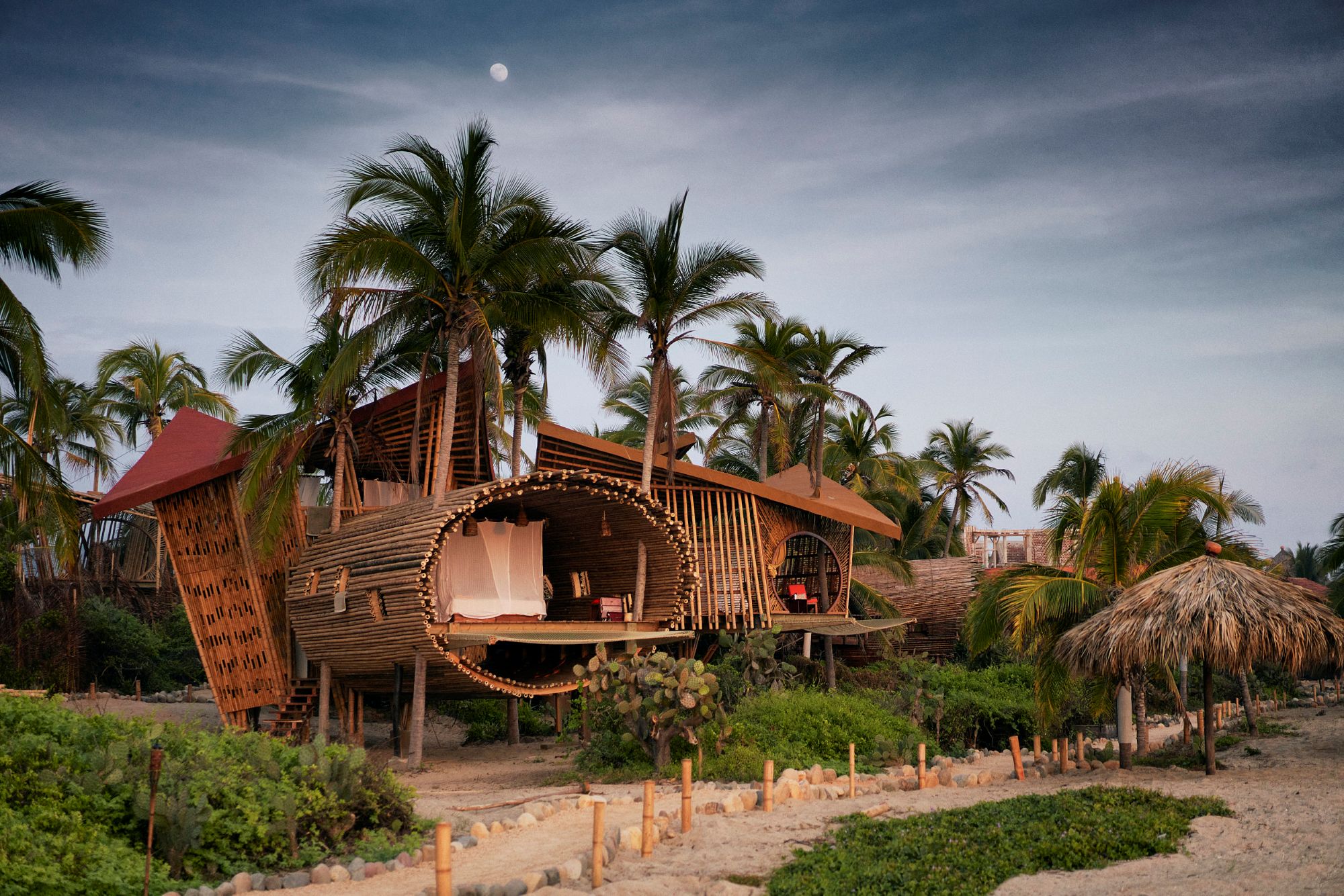
This is the process of History of Place, and through that process we define a solution that is not “sealing soil” but rather unsealing soil, bringing back water and life to that soil, and developing in a way that nourishes life and abundance in that place. Real “greenfields” very rarely exist. Playa Viva, while a natural landscape, was once dense low coastal forest, thriving with life, but humans degraded it via slash-and-burn agriculture and cattle ranching. We have regenerated that low coastal forest while building a thriving hotel that is also regenerating the local community and watershed. Thus we are proving that you do not have to “seal the soil” but rather “heal the soil.”
Editor: Thank you, David. You have made a compelling case for regeneration as good business and for working within the system to transform it.